
One Registration, Every UK-Licensed Site
GamStop is the UK’s national online self-exclusion scheme. It allows anyone living in Great Britain to sign up once and be blocked from all gambling websites and apps that hold a licence from the UK Gambling Commission. The service is free, runs independently of the operators themselves, and has been operational since April 2018. In the years since launch, it has quietly become one of the largest harm-reduction tools in British gambling — yet most casual players have never heard of it until they need it.
The scheme sits under the umbrella of the National Online Self-Exclusion Scheme Limited, a not-for-profit company funded by the gambling industry as a licence condition imposed by the UKGC. Every operator that holds a remote operating licence must participate. There are no opt-outs. If a casino, sportsbook, bingo site or poker room is licensed to serve the British market, it is plugged into GamStop’s system. That gives the scheme a reach that individual operator self-exclusion tools simply cannot match — one form, one process, and every compliant site falls into line.
Understanding how GamStop works matters whether you intend to use it or not. For players considering casinos outside the GamStop network, the scheme’s scope and its blind spots define where the safety net ends. For those thinking about self-exclusion, knowing the mechanics upfront prevents nasty surprises later. And for anyone researching the broader landscape of UK gambling regulation, GamStop is a useful case study in what a coordinated national approach looks like — and where it falls short.
Our top casino picks for the UK
- AmunbetBonus: Join now and get 450% up to 2,700 GBP + 450 FS · Payout speed: 1-3 business days
- SpinFormulaBonus: 550% Up To £15,000 + 550 FS · Payout speed: 1-3 business days
- BeOnBetBonus: 100% up to €500 + 100 FS · Payout speed: 1-3 business days
- BritsinoBonus: Welcome Package – Get your £2,200 + 2,000 FS · Payout speed: 1-3 business days
- ZombillionBonus: Welcome Pack 250% up to £4000 + 200 FS · Payout speed: 1-3 business days
- x3betBonus: Welcome Pack 100% Up to £1.000 + 200 Free Spins · Payout speed: 1-3 business days
- NightWinBonus: £900 + 400 free spins · Payout speed: 1-3 business days
- Revery PlayBonus: 100% up to€1,000+ 100 FS · Payout speed: 1-3 business days
- ChanzeBonus: Slots Welcome Bonus #1 200% up to €500 · Payout speed: 1-3 business days
- NightLuckBonus: Welcome Pack + 805% Up To 6400€ + 280 FS · Payout speed: 1-3 business days
How Registration Works
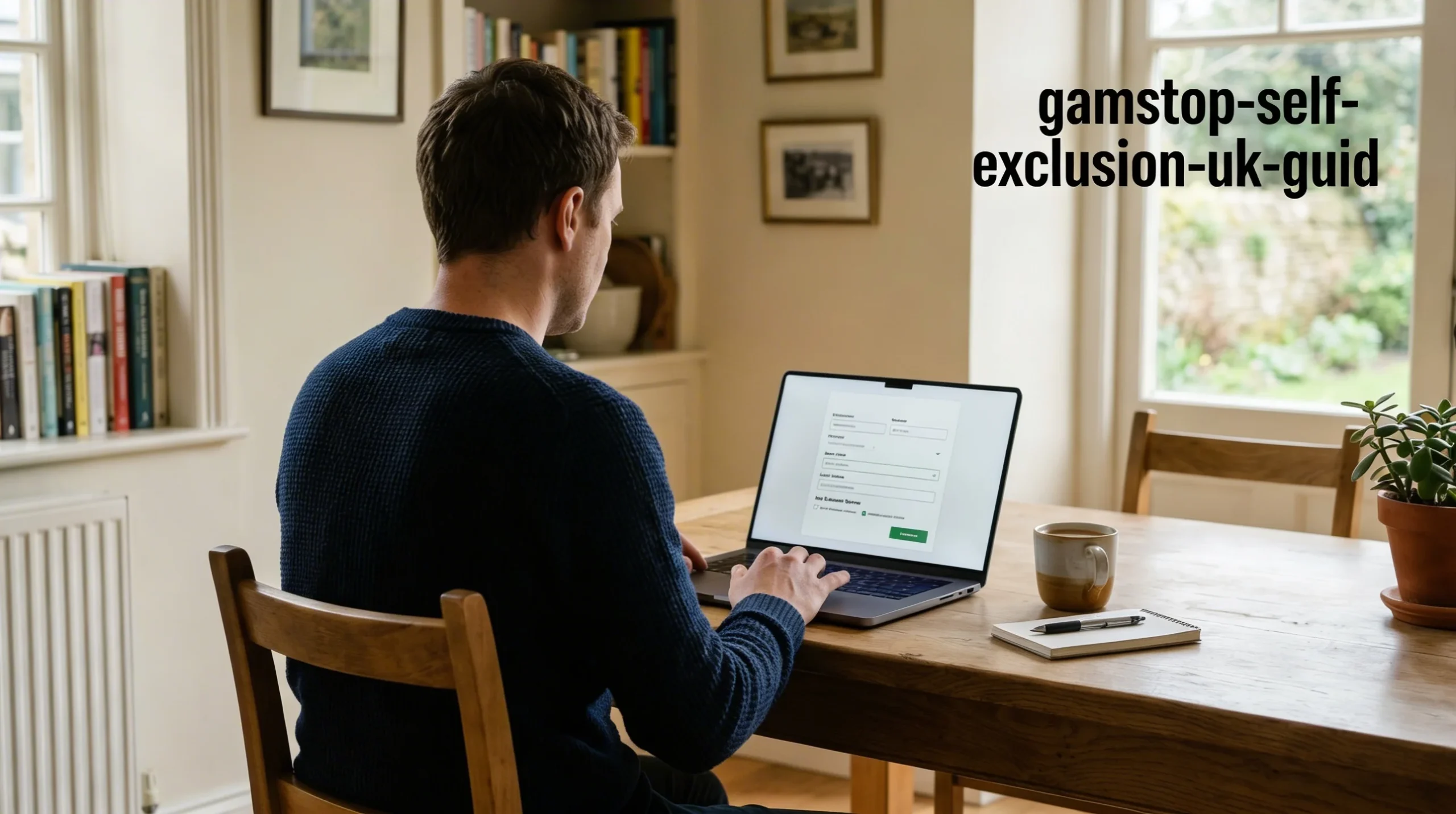
The sign-up process is deliberately simple. You visit gamstop.co.uk, enter your name, date of birth, email address, home address, and phone number. GamStop uses these details to match your identity across operator databases, so accuracy matters — a misspelled surname or an outdated address can leave gaps in coverage. Once submitted, the exclusion takes effect within 24 hours for most operators, though the scheme advises that full propagation across all sites may take a short time longer.
You then choose a self-exclusion period: six months, one year, or five years. There is no lifetime option in the traditional sense, although since December 2024 GamStop has offered a five-year term with automatic renewal — a response to an Ipsos evaluation that recommended a permanent self-exclusion pathway. The period you select is binding. During that window, you cannot reverse or shorten your exclusion. Once it expires, you must actively request reinstatement; the block does not lift automatically. That last detail catches some people off guard.
The scale of uptake tells its own story. Since launch, roughly 600,000 people have registered with GamStop — more than one percent of the UK’s adult population, according to data reported by Gambling Insider. That figure is not static. In 2024 alone, 99,186 individuals signed up, a 7.7 percent increase over the previous year, according to NEXT.io reporting on GamStop’s annual figures. The trajectory has been consistently upward, driven in part by growing awareness and in part by regulatory pressure that has made GamStop’s link more visible on operator websites and in marketing materials.
After registration, the practical experience is straightforward. Attempt to log into a UKGC-licensed gambling site and you will be denied access. Try to open a new account and the identity-matching system should flag you. Some operators also remove your existing marketing preferences, though enforcement of that varies. The system is automated at the operator end — GamStop pushes exclusion data to participating sites, which are required to check against it when processing logins and new registrations.
Coverage and Limitations
GamStop covers every gambling operator licensed by the UKGC for remote (online) operations. That includes online casinos, sportsbooks, bingo platforms, poker rooms, and spread-betting firms. It also extends to gambling apps available through UK app stores, provided the operator holds the relevant licence. In raw numbers, this encompasses hundreds of brands and thousands of individual websites — virtually every legal online gambling option available to British residents.
The boundaries are equally important. GamStop does not apply to land-based venues. Walk into a high-street bookmaker or a casino in central London, and your GamStop registration will not stop you from placing a bet. Those venues have their own self-exclusion schemes — MOSES for bookmakers, Bacta for arcades, and individual casino-group programmes — but none of them are linked to GamStop’s database. The systems operate in parallel, not in concert.
The National Lottery and its scratchcards also fall outside GamStop’s remit. Camelot (now Allwyn) operates under a separate licence framework, and although some responsible-gambling integrations have been discussed, GamStop cannot currently block lottery purchases, whether in-store or online. The same applies to certain society lotteries and prize competitions that sit in regulatory grey areas.
Then there is the offshore gap — arguably the scheme’s most discussed limitation. Casinos, sportsbooks, and poker rooms that do not hold a UKGC licence are not required to participate in GamStop and, in practice, none of them do. An operator licensed in Curaçao, Malta, or Gibraltar but lacking a UK-specific licence has no technical or legal obligation to check the GamStop register. This is not a bug; it is a structural feature of a system designed around domestic regulatory compliance. But it means that a self-excluded player who is determined to gamble can find offshore platforms that will accept them without friction.
The demand for the service continues to grow in ways that underscore both its value and its limits. Registration numbers have climbed year on year since launch, with no sign of plateauing. Every new sign-up represents someone who decided the safety net was worth using, even knowing that it does not stretch across the entire gambling landscape. Whether that growth reflects better awareness, a worsening problem, or both is a question the numbers alone cannot answer.
Conclusion
GamStop does one thing and does it at scale: it gives anyone in Great Britain a single switch to turn off access to every UKGC-licensed gambling site. The registration process takes minutes, the exclusion kicks in within hours, and the commitment is real — you cannot reverse it mid-term. For hundreds of thousands of people, that has been exactly the intervention they needed.
Where the scheme cannot help is beyond the border of UK regulation. Land-based venues, the National Lottery, and offshore casinos all sit outside its reach. Knowing those boundaries is not a reason to dismiss GamStop — it is a reason to understand it properly. Self-exclusion works best when you know what it covers, what it does not, and what additional steps might be worth taking alongside it.
Disclaimer:
This article is provided for informational purposes only and does not constitute legal, financial, or gambling advice. Gambling involves risk, and you should never wager money you cannot afford to lose. If you or someone you know is struggling with gambling-related harm, free and confidential support is available through the National Gambling Helpline on 0808 8020 133, operated by GamCare, or via BeGambleAware.org. The information in this article was accurate at the time of writing but may be subject to change as regulations evolve.
What Is GamStop and How Does Self-Exclusion Work? — More on this topic at casinos not on gamstop.
See also Are Non-GamStop Casinos Safe? A Verification Guide.